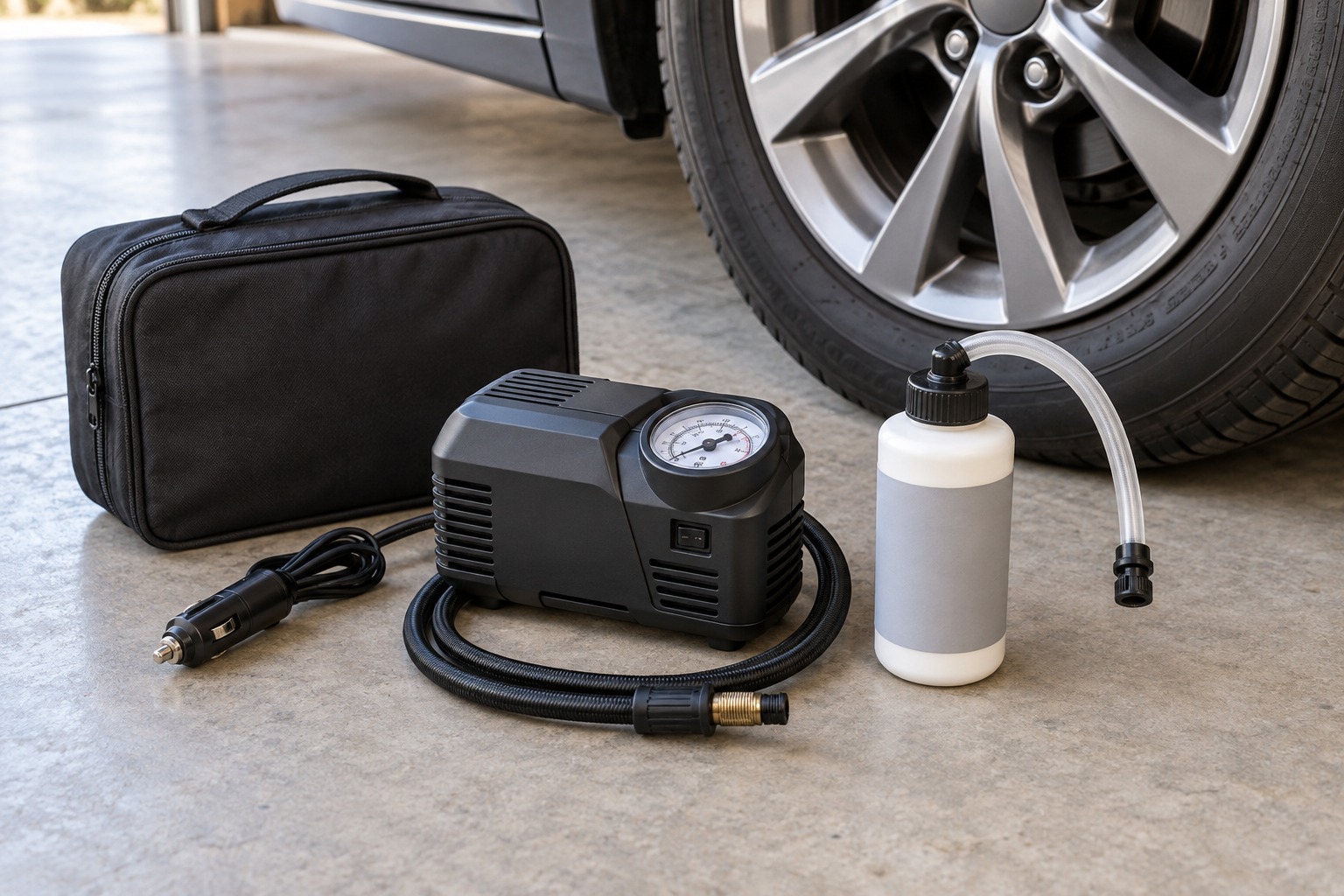
A tire-repair kit may look complete while containing an expired sealant bottle or a connector that is missing from its pouch. Take it out and identify every component before a long journey. If it came with the vehicle, use the vehicle's manual and the kit's own instructions together.
Portable kits are not a solution for every type of tire damage. The location and size of a puncture, sidewall damage and the condition of the tire can determine whether a kit is usable. Do not assume that adding more sealant or air makes an excluded type of damage repairable.
Understand the sequence before it is urgent
Read the procedure from beginning to end without operating the equipment. Identify the power connection, hose, pressure display and any selector controls. Check how the kit is meant to be powered and whether it is compatible with the vehicle's available outlet. Do not improvise connections to make a plug fit.
Find the sealant's use-by date and replacement instructions. If the bottle has already been used, the kit may no longer be ready for another incident. Store it within the specified temperature range and protect it from damage and leaks.
If the compressor supports a separate inflation function, test or inspect it only as the instructions allow. A practice session should not inject sealant into a healthy tire merely to see the system operate. Ask a service professional to explain unfamiliar components if the documentation is unclear.
Keep the follow-up instructions with the kit
Temporary repairs may have speed, distance and recheck requirements. Write down where those instructions are located rather than trusting memory. A tire that appears to hold air immediately afterward still needs the professional assessment specified by the vehicle or kit manufacturer.
Tell the tire service provider when sealant has been used. Keep the product information available, including any instructions concerning the tire-pressure monitoring system. Do not present the kit as a permanent repair unless the specific manufacturer and professional inspection establish that outcome.
Your stopping location matters as much as the tools. Do not attempt a repair where traffic, visibility or ground conditions make it unsafe. Keep roadside-assistance details available and consider that help part of the plan. The kit's purpose is to give an appropriate option in suitable circumstances, not to require you to use it whenever a tire loses pressure.