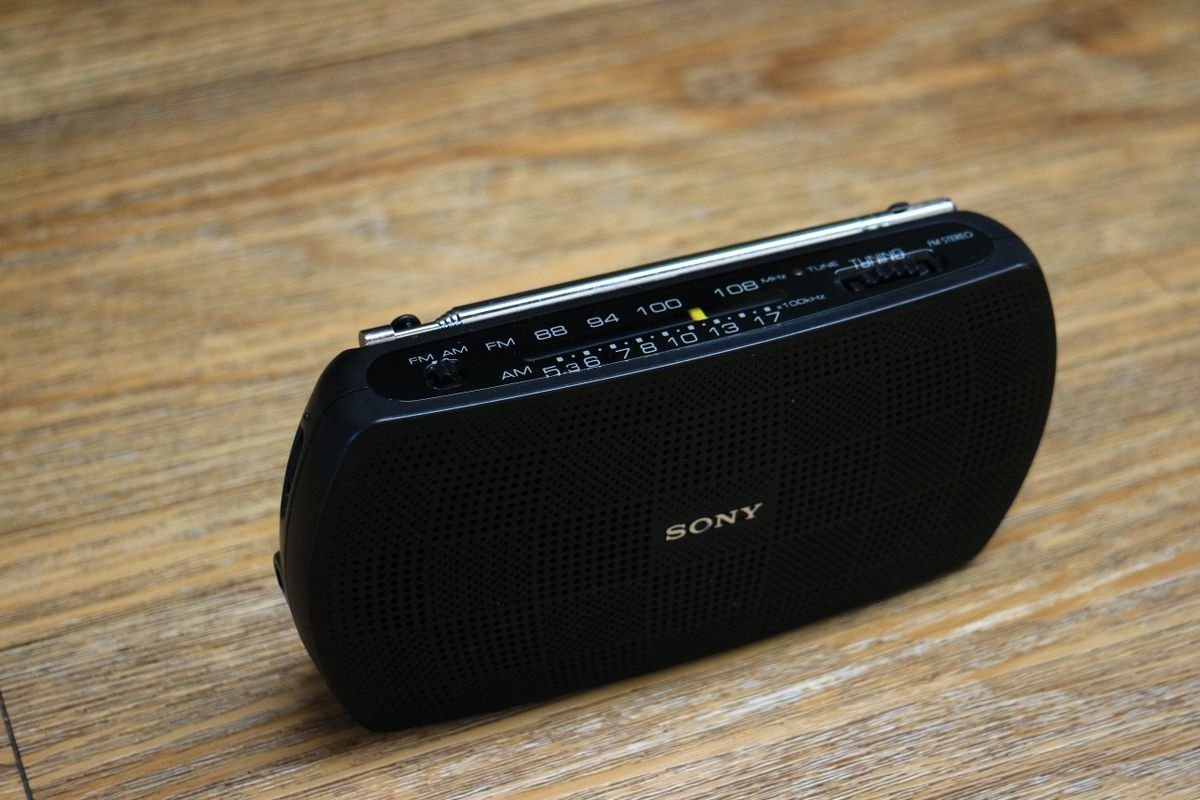
A radio can provide another route to information when a phone is flat or the network is unreliable. It still needs preparation. A receiver left in its box has no established station, no checked batteries, and no proof that it receives a useful signal in your home.
Decide whether you want ordinary local broadcasts, NOAA Weather Radio, or both. The National Weather Service explains that NOAA weather broadcasts use dedicated VHF frequencies; a basic AM/FM receiver cannot receive them. Read the supported bands rather than assuming every product labeled “emergency radio” has the same features.
Find reception where the radio will live
Try the radio in the room where it will be used. Adjust its antenna as instructed and listen long enough to confirm the broadcast is intelligible. A good signal in the store or beside an upstairs window does not establish reception on a basement shelf.
Keep a note of the useful station or channel. For a NOAA receiver with SAME alerts, program the appropriate local area using the NWS guidance and the radio's manual. NWS cautions that choosing a clearer but inappropriate transmitter can prevent the expected area alerts. Verify the local transmitter and settings rather than choosing solely by loudness.
Consider how an alert will reach household members. Some receivers support external visual or vibration devices, but those accessories and their power arrangements must be checked for compatibility. A radio nobody can hear from the sleeping area needs a different placement or an appropriate notification arrangement.
Test the backup source
If the radio normally plugs into the wall, install and maintain its specified backup batteries. Check the manual's method for confirming operation without mains power. Notice whether the clock, station memory, and alert settings survive the change.
A hand crank or small solar panel may provide supplementary charging on some products, but do not assume a brief turn of the handle supplies a whole night of listening. Use the manufacturer's stated procedure and test the actual product. Keep a dependable charged or fresh power source ready for the role you assign it.
Store the radio where it can be reached, not behind the rest of the supplies. Practice changing volume and switching between listening and alert modes. After a move, repeat the reception and area-programming checks; the old settings may no longer match your location.
This is a useful backup channel, not a guarantee that every transmitter will remain available. Continue to follow local instructions and maintain more than one way to receive information where possible.